
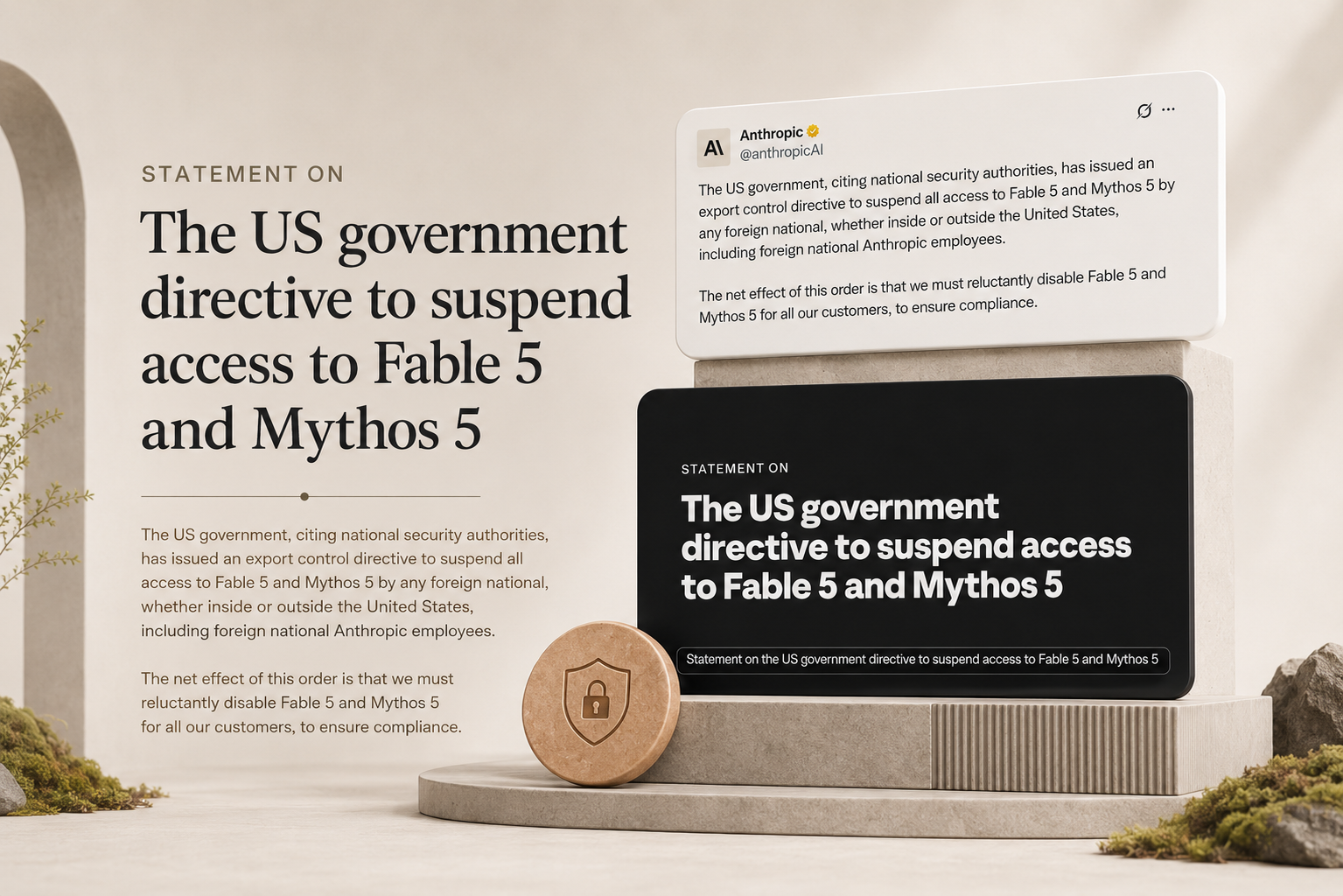
On Friday evening, a single letter took two of the most capable AI models on the planet offline. Most of the coverage I've read frames this as a story about government overreach, or about one company's clash with Washington. Both readings are fair. But I think they miss the part that actually matters for anyone building serious systems on top of AI.
The real lesson is not political. It is architectural.
For years I've argued that the questions worth asking about AI are not "how big is the model?" or "what did it score on the benchmark?" The questions that decide whether a system survives contact with reality are different: Can you govern it? Can you predict it? Can you audit it? And — the one Friday just put a spotlight on — do you actually control your access to it?
Friday answered that last question for an entire industry, in public, and the answer was no.
Let me walk through exactly what happened, because the details matter, and then explain why I think this is the clearest signal yet that the strategic center of gravity in AI is shifting from capability to control.
What actually happened
At 5:21 p.m. Eastern on June 12, 2026, Anthropic received an export control directive from the U.S. government, citing national security authorities. The directive came as a letter from Commerce Secretary Howard Lutnick to Anthropic CEO Dario Amodei. It placed two models — Claude Fable 5 and Claude Mythos 5 — under export controls, requiring a license for their export, re-export, or even domestic transfer to any foreign national.
Read that last part carefully, because it's the crux. The restriction did not just apply to users in other countries. It applied to any foreign national anywhere, including foreign nationals inside the United States, and including Anthropic's own foreign-born employees. There is no practical way for a cloud platform to verify, in real time, the citizenship of every person sending it a request. So Anthropic faced a binary: build an impossible filter, or shut the models off entirely. It chose to shut them off — for every customer worldwide, U.S. citizens included. Its other models stayed online.
A bit of background on the two models, because it's relevant to the supposed justification. Mythos 5 and Fable 5 are, underneath, the same model. The difference is safeguards. Mythos is the less-restricted version made available to a small set of trusted partners, particularly for cybersecurity work. Fable 5 is the publicly released version, wrapped in safety classifiers designed to block responses in high-risk domains. Fable had been public for only three days when the order arrived.
The government's stated concern, as best anyone can tell, is a "jailbreak" — a method of bypassing Fable's guardrails. Anthropic says the letter offered no specific technical explanation. According to the company, the technique it was shown was narrow: essentially, asking the model to read a particular codebase and identify software flaws. Anthropic argues the vulnerabilities this surfaced were minor, already publicly known, and discoverable using other widely available models — including competitors' — without any special bypass at all. It points to more than a thousand hours of pre-launch red-teaming, conducted with the government, the UK's AI Security Institute, and outside organizations, none of which found a universal jailbreak capable of broadly defeating Fable's protections.
Reporting from Axios added the government's side: an administration official said Commerce acted after another company claimed it had jailbroken Mythos, that the administration had earlier urged Anthropic to delay the release, and that the models would stay locked down until the government's own security posture was "hardened," possibly within weeks.
And there is a backdrop that makes the timing impossible to ignore. Earlier this year, after negotiations broke down, the Department of Defense designated Anthropic a "supply chain risk" — a label historically reserved for foreign adversaries — reportedly after the company drew lines around military and surveillance uses of its technology. Anthropic sued to reverse that designation, and the litigation is ongoing. So an export order landing on a Friday evening, three days after a flagship launch, over a vulnerability the company says reveals nothing new, can be read as a safety intervention — or as the next move in an escalating feud. Probably it's some of both.
Those are the facts. Now here's why I think they point somewhere most of the commentary isn't looking.
The thesis: if access can be revoked, then access is a dependency
Strip away the politics and one sentence remains:
A capability your organization relies on can be switched off by a third party, on short notice, for reasons you will never be told.
That is not a story about Anthropic. Anthropic is the example, not the subject. The subject is what happens to you when the most important capability inside your business is owned, hosted, governed, and ultimately controlled by someone else.
This is the same argument I've been making about AI for a long time, just arriving from a new direction. We usually discuss determinism at the model layer: Does the system behave consistently? Can its decisions be explained, its outputs traced, its failures understood? Those questions don't disappear. But Friday added a layer on top of them. It turns out that determinism doesn't stop at the model's behavior. It extends to your access to the model — because an unavailable model is every bit as useless as an unreliable one. A system that produces perfect outputs and then vanishes overnight has not solved your problem. It has become your problem.
So the dependency question is really a determinism question wearing different clothes. And it forces a set of questions that I'd argue every serious AI buyer now has to answer honestly:
- What do we actually own, versus merely rent?
- What is our contingency plan if access disappears tomorrow morning?
- Who controls the intelligence layer of our business — us, or someone whose incentives and obligations we don't share?
- How quickly could we fail over to something we control, and how much capability would we lose in doing so?
These are not technical preferences. After Friday they are operational requirements.
Why this strengthens the case for sovereignty, not weakens it
There's an irony in this episode that I don't want to lose. An action framed entirely around control — the state asserting control over a powerful capability — is, I think, going to push the market toward architectures that are fundamentally harder to control from the outside.
Sovereign AI, on-premise deployment, local inference, self-hosted systems, private infrastructure — for a long time these were often treated as either political slogans or the cautious preferences of regulated industries. Friday reframes them as risk management. Once you accept that hosted frontier access can be revoked by a party outside your organization, the value of owning your stack stops being abstract. A model you run inside your own infrastructure has one property that no hosted frontier model can promise: it cannot be remotely switched off by a letter you never see.
That doesn't mean self-hosting is free. It costs capability, talent, and money. But the calculation has changed. The question is no longer "which model is smartest?" It is "which model can we depend on?" — and those can be very different answers.
Why this is the strongest argument yet for smaller, specialized models
This is where I'd push hardest against the prevailing assumption that bigger is always better.
A massive frontier model hosted by a third party will, in raw terms, outperform a smaller one. But it is also more centralized, more dependent, and more exposed to policy decisions made entirely outside your organization. A smaller language model — domain-specific, efficient, running at the edge or on your own hardware — gives up some absolute capability. In exchange it offers ownership, availability, predictability, and resilience.
For a long time those traits read as a fair trade only to the risk-averse. Friday repriced them. Resilience is no longer a defensive nicety; it is a strategic asset. When the frontier model many enterprises had just started building on disappeared, the fallback was reverting to an older model. Imagine if the fallback had instead been a capable, specialized system you fully owned and could never have lost. That is the architecture this event quietly argues for.
The case for SLMs and micro-LLMs has usually been made on cost and latency. I think it now has to be made on sovereignty too. The smaller model isn't just cheaper to run. It's the part of your stack nobody else can turn off.
Where the honest disagreement lives
I want to be intellectually fair, because the most interesting reactions to this don't line up neatly behind any one view.
The sharpest critique I've seen is uncomfortable for the safety-first crowd: that Anthropic helped write the script that's now being used against it. The company spent two years describing these capabilities as potentially catastrophic, and marketed Fable as the carefully-guardrailed version of a model deemed too dangerous to release raw. A cybersecurity researcher made the point on X that if you brand your product as a munition for long enough, the government eventually regulates it like one — the legal predicate, in that telling, was authored by the company itself. I find that hard to dismiss. You don't get to spend years telling the state your technology is a weapon and then act surprised when the state treats it as one.
The same critic raised a second point worth holding onto: the U.S. tried to export-control strong encryption in the 1990s, and it failed — the capability escaped anyway. Software is far slipperier than silicon, and history is not kind to the belief that you can border-control an algorithm. That cuts against the government's whole approach here.
On the other side, Anthropic's substantive defense is reasonable. If the triggering vulnerability really is narrow, already public, and reproducible on competitors' models, then pulling a product used by hundreds of millions of people is disproportionate, and the precedent — that a government can disable a commercial AI product worldwide on unpublished evidence — is genuinely dangerous regardless of who's right about the specific flaw.
So the camps, roughly: a responsible state catching real risk early; a disproportionate and opaque action setting a terrible precedent; and a company being held to the dangerous framing it chose. I hold pieces of all three. But notice that every one of those readings leads to the same place for a builder. Whether the government was right, wrong, or settling a score, the capability to revoke access has now been demonstrated in public. That fact survives every interpretation of the politics.
The bottom line
Here is my actual position. On the narrow facts available, the government's action looks disproportionate and dangerously opaque — you don't pull a tool from millions of people on evidence you won't publish and expect trust to survive. I'd hold that view loosely, because the story is barely a day old, the government has said almost nothing, and much of the technical detail comes from the party with the strongest incentive to dispute the order.
But the part I'm not uncertain about is the architectural lesson, and it's the one I'd want anyone planning an AI strategy to internalize:
If intelligence becomes infrastructure, then ownership, governance, and control of that infrastructure matter as much as the intelligence itself.
Friday didn't change what these models can do. It changed what we know about who controls them — and it proved, in public, that the off-switch is real and sits in someone else's hand. The organizations that absorb that lesson will stop optimizing purely for capability and start optimizing for control. The ones that don't will keep building their most critical systems on a dependency they don't own and can't protect.
The off-switch used to be hypothetical. As of Friday, it isn't. Build accordingly.
This is my own analysis as of June 13, 2026, not reporting. It's a fast-developing story built largely on Anthropic's account and early industry reaction, so treat my confidence about the specifics accordingly and watch what the government and the company disclose next. The architectural argument, though, doesn't depend on how the politics resolve.