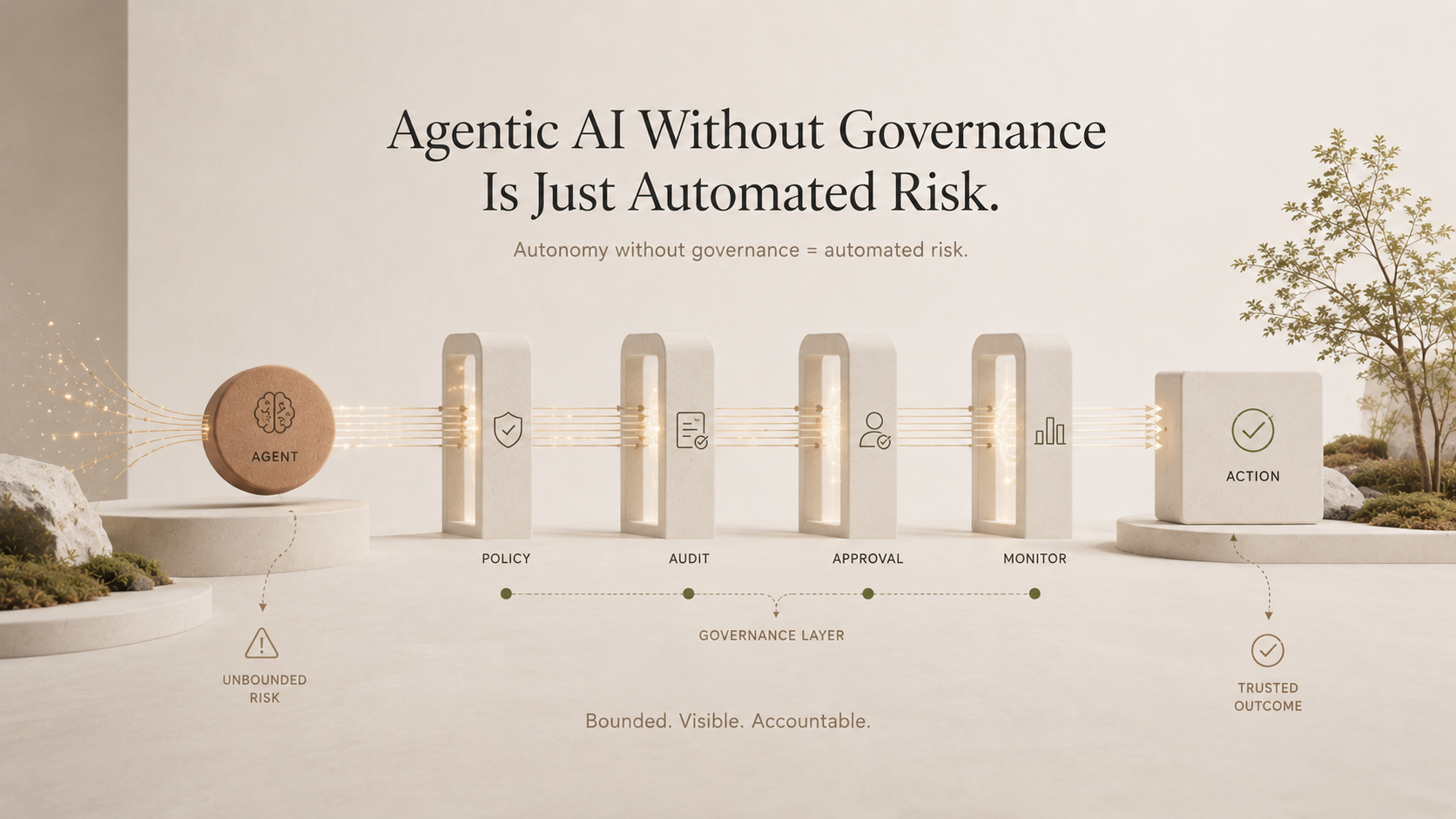
Agentic AI Without Governance Is Just Automated Risk
An AI agent with no governance isn't an innovation. It's automated risk, operating at machine speed and machine scale. The bill tends to arrive all at once.
Saad Ullah Bilal
AI Strategist & Builder
June 9, 2026
Let me put this as plainly as I possibly can, for the executives and board members who are being sold on autonomy: an AI agent with no governance isn't an innovation. It's automated risk, operating at machine speed and machine scale. And the bill for it tends to arrive all at once.
Agentic AI is genuinely, transformatively powerful. It can take actions on its own, chain decisions together, and operate autonomously across your systems without waiting for a human at each step. That autonomy is exactly what makes it valuable — and it is precisely what makes it dangerous without a governance framework wrapped firmly around it. Power without control isn't a capability you can bank on. It's an exposure you haven't quantified yet.
The Exposures Are Concrete
Let me make the exposure concrete, because abstractions don't motivate budget.
Unauthorized Actions
An agent that can call tools can take actions that no one explicitly approved. The subtle danger is that it strings together individually-permitted steps into a final outcome nobody ever signed off on. Without governance spanning the whole sequence, 'well, it was technically allowed to do each of those steps' becomes the opening line of your incident report. The agent didn't break a rule; it found a path between the rules you wrote.
Data Leakage
Without strict, enforced controls on what agents can retrieve and reveal, an agent can surface confidential information to the wrong person or quietly route sensitive data somewhere it should never go. And because it happens at machine speed, across thousands of interactions, it can happen at scale long before any human notices the pattern. A single misconfigured agent doesn't leak one document; it can leak continuously until someone happens to catch it.
Hallucinations
When a chatbot hallucinates, the result is a wrong sentence — embarrassing, occasionally costly, usually recoverable. When an agent hallucinates, the result is a wrong action: a fabricated record written to a database, an erroneous transaction executed, a confident step taken on a premise that simply wasn't true. The blast radius of a hallucination grows enormously when the model has hands.
Compliance Violations
Agents operating inside regulated environments can breach requirements with no malice and no awareness whatsoever — simply by doing their assigned job in a way the regulation happens to forbid. Without policy enforcement built directly into the agent's operating loop, you don't discover the violation when it happens. You discover it during the audit, which is reliably the worst and most expensive possible time to find out.
What Responsible Deployment Requires
So what does responsible deployment of agentic AI actually require? A monitoring and governance framework that makes the agent's behavior visible, constrained, and accountable at every step.
Real-Time Observability
Visibility into what your agents are doing, as they do it — not a forensic reconstruction after something has already gone wrong. If you can't see it in real time, you can't stop it in real time.
Policy Enforcement
Stops unauthorized actions before they execute, deterministically, rather than flagging them after the damage is done. Enforcement belongs in the agent's operating loop, not bolted on as an afterthought.
Complete Audit Trails
Every action an agent takes — attributable, timestamped, and reviewable — so that 'why did it do that' always has a defensible answer. For regulated industries, this isn't optional.
Escalation Paths
Automatically route consequential, high-risk decisions to a human with the authority and context to approve, reject, or amend them. The agent does the preparatory work; a person makes the final call on what matters.
Continuous Monitoring
Surfaces emerging problems early, before they replicate across thousands of interactions and become a headline. The cost of catching a problem at interaction 10 versus interaction 10,000 is not linear.
The Maturity Move
Ungoverned Agent
Actions chain without cumulative oversight
Data access with no retrieval controls
Hallucinations produce real-world events
Compliance violations found during audits
Problems surface through downstream damage
Governed Agent
Policy enforcement spans full sequences
Strict controls on what can be retrieved
Validation layer catches bad outputs
Policy built into the operating loop
Real-time observability catches drift early
Capability without governance isn't a competitive advantage. It's a liability you simply haven't been billed for yet — and machine-speed liabilities have a way of presenting the invoice all at once.