Stop thinking of your AI agents as software. They take actions, make decisions, access systems, and produce work the business depends on. We already have a framework for that.
Saad Ullah Bilal
AI Strategist & Builder
June 9, 2026
Here's a reframe that makes the entire problem of enterprise AI governance suddenly click into place: stop thinking of your AI agents as software, and start thinking of them as employees.
Because functionally, that is now what they are. They take actions. They make decisions. They access systems, touch data, and produce work that the business genuinely depends on. We already have a sophisticated, centuries-refined, battle-tested framework for managing entities that do exactly those things. We call it employment — and almost everything we've learned about managing people transfers directly.
"
The organizations that get AI agents right won't be the ones that treated them as magic or as mere code. They'll be the ones that treated them as headcount — with all the structure, accountability, performance management, and oversight that hiring a capable but fallible new worker has always implied.
Walk Through What Every Employee Has
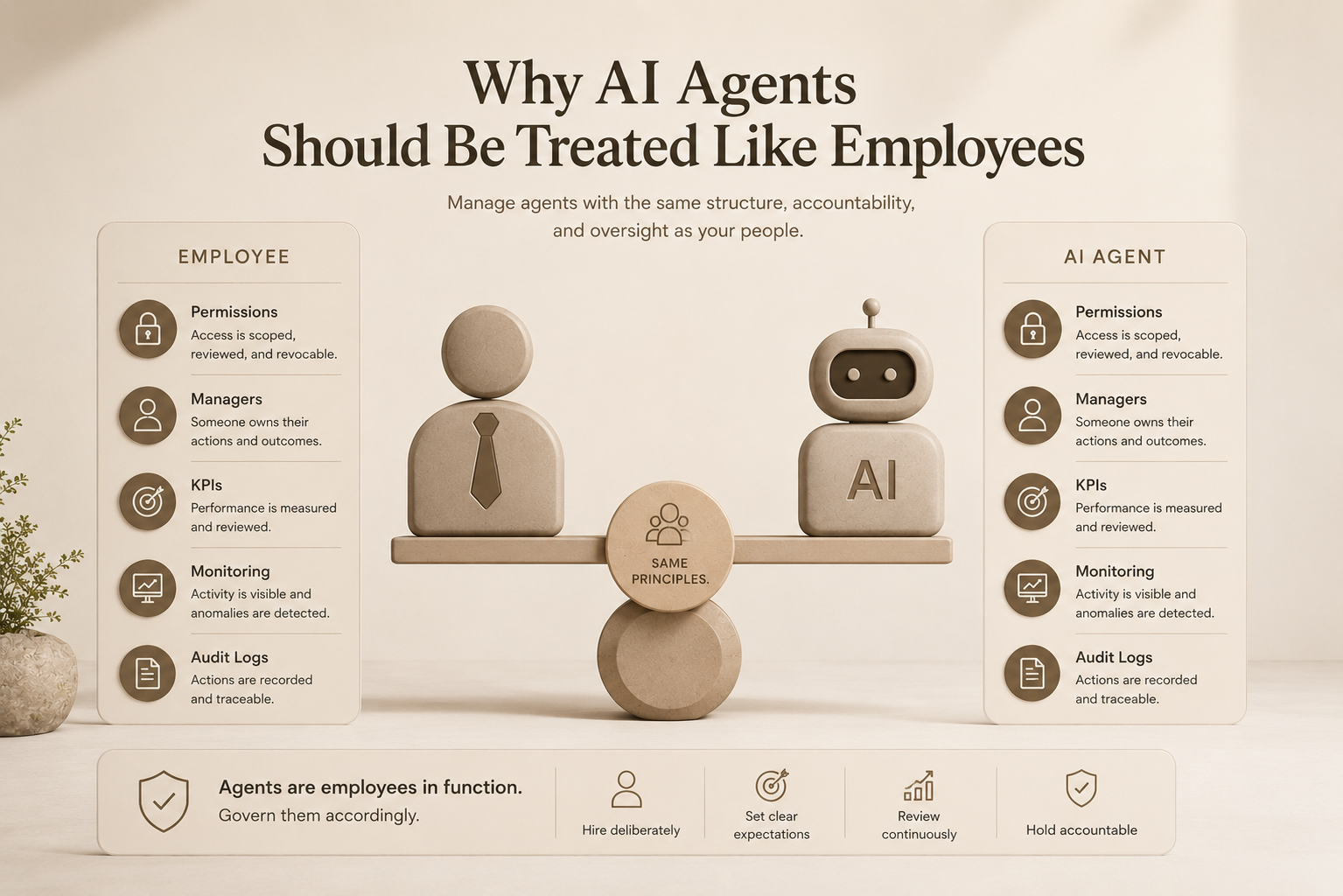
Walk through what every employee in your organization has, and ask whether your agents have the equivalent.
Permissions
Nobody gets the keys to everything on their first day. Access is scoped tightly to the role, granted deliberately, reviewed periodically, and revoked the moment it's no longer needed. An agent with broad standing permissions 'just in case' is the exact equivalent of handing a new hire admin rights to every system in the building. We'd never do that with a person. We do it with agents constantly, and then act surprised by the consequences.
Managers
Every employee answers to someone with the authority and responsibility to direct them, correct them, and override them when they're about to make a mistake. Agents need an unambiguous equivalent: a clearly identified human or system that owns the agent's behavior, monitors its decisions, and can step in to stop or redirect it. An agent that reports to no one is accountable to no one.
KPIs
Employees are measured. We know whether they're performing well, where they're struggling, whether they're improving or declining over time. Most deployed agents have no equivalent at all — they're switched on and run indefinitely, with no one tracking whether they're actually doing their job well or quietly degrading. Define what good looks like, and measure against it continuously.
Monitoring
Not surveillance for its own sake, but ordinary management visibility. Agents operating inside an opaque black box deny you that entire early-warning system — and because they act at machine speed and scale, by the time a problem becomes visible through its downstream effects, it has often already replicated itself across thousands of interactions. Visibility has to be built in, not retrofitted after the first incident.
Audit Logs
When something goes wrong with an employee's work, you can reconstruct what happened. Agents need exactly the same: a complete, attributable, timestamped record of what they did and the reasoning or inputs behind it. Without it, every agent failure becomes an unsolvable mystery — and 'we're not sure why it did that' becomes an answer you have to give to people who will not find it acceptable.
The Governance Framework Already Exists
How We Manage Employees
Scoped access granted through approval
Clear reporting line and accountability
Performance measured against defined KPIs
Management visibility into day-to-day work
Paper trail for decisions and actions
How Most Agents Are Deployed
Broad permissions granted for convenience
No clear owner or oversight structure
No performance baseline ever established
Opaque operation with no visibility
No audit trail — failures become mysteries
The Maturity Move
Notice what's striking about every item on that list: none of it is exotic, novel, or AI-specific. We are not inventing new governance from scratch for a new kind of entity. We are applying the governance we already perfected over generations of managing human workforces. The framework exists. We just have to recognize that it applies.
Hire your agents the way you'd hire a person — scoped, deliberate, with clear expectations. And manage them the way you'd manage one. The discipline isn't new. Only the entity it applies to is.