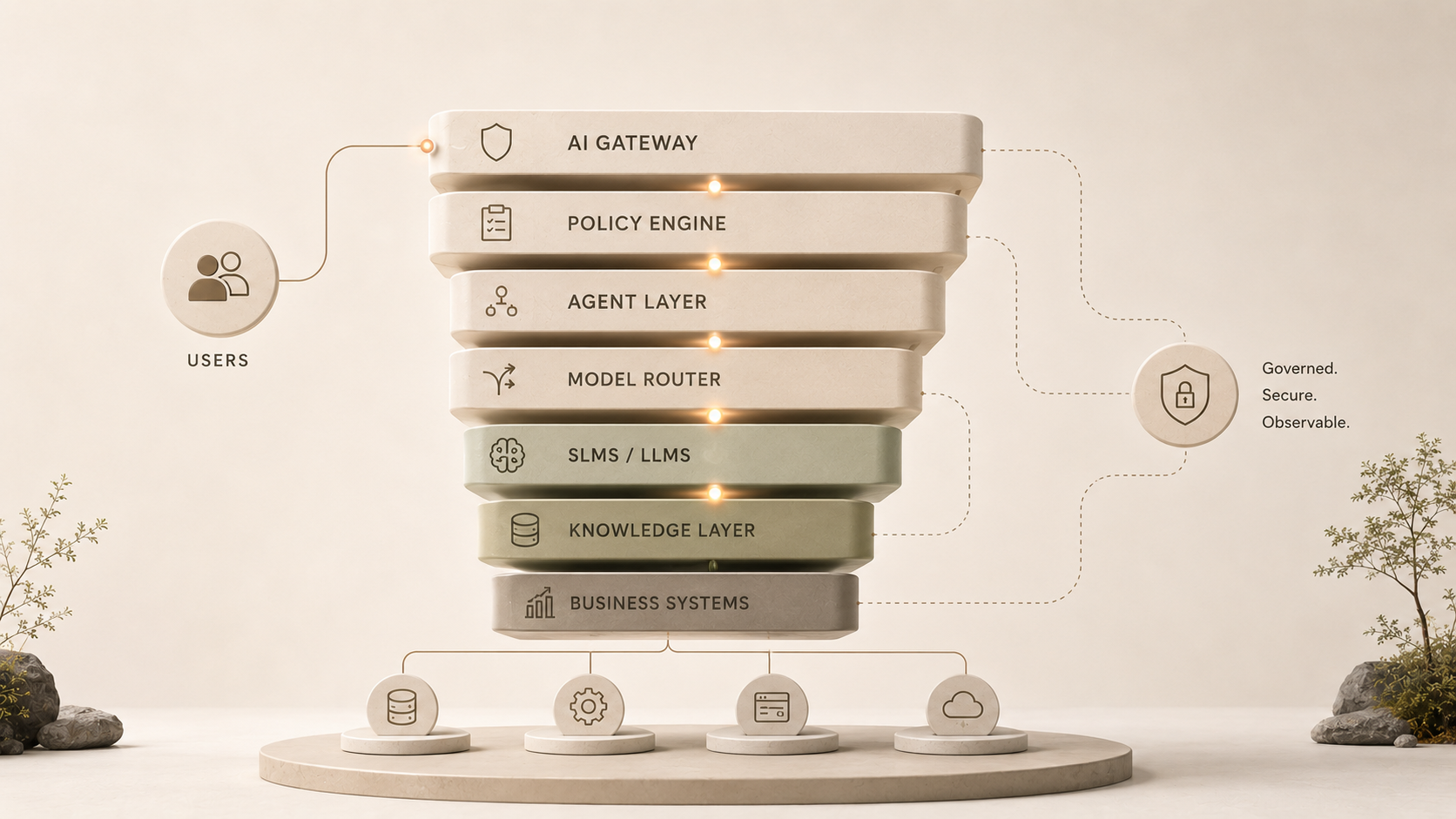
Enterprise AI is converging on a reference architecture. The model sits in the middle — surrounded by layers of control, governance, routing, and integration. That ordering is the entire point.
Saad Ullah Bilal
AI Strategist & Builder
June 9, 2026
Every era of computing eventually settles into a reference architecture — a standard set of layers that the whole industry roughly agrees on, even when the specific tools differ. The web has one. Cloud-native has one. And enterprise AI is now visibly converging on one of its own.
"
In 2026, the model is a commodity component. The architecture around it is the product.
The Reference Architecture
Here's the shape it's taking — and the ordering is the entire insight:
Users → AI Gateway
Users sit at the top — employees, customers, partner systems. Every request carries an identity, and the AI Gateway is the single controlled front door. Just as no competent organization exposes every internal service directly to the internet, you don't expose every model and agent directly to users. The gateway centralizes authentication, rate limiting, request logging, and routing — one guarded entry point you can reason about.
Policy Engine
Where governance actually lives and executes. Before a request proceeds anywhere meaningful, this layer asks and answers the central question: is this permitted — for this user, in this context, right now? Your RBAC and ABAC rules live here. This is the layer that transforms a vague, dangerous 'the AI can do anything' into a precise, defensible 'the AI can do exactly what it should, for exactly the people who should be able to ask.'
Agent Layer
Orchestrates multi-step work. When a request requires planning, tool use, and a sequence of coordinated actions, this layer decides what needs to happen and in what order. Crucially, it does all of this within the boundaries the policy engine has already enforced. The agent layer is powerful, but it is not sovereign.
Model Router → SLMs / LLMs
The traffic controller for intelligence itself. Rather than sending every task to one default model, the router inspects each task and decides which model should handle it — simple classification to a small, cheap model; complex reasoning to a frontier model. This is where cost and latency get optimized automatically. Below it sits a portfolio of models, not a monolith.
Knowledge Layer
Where retrieval and governed data access live — and 'governed' is doing real work. This layer isn't just 'find the relevant document.' It's 'find the document this specific user is actually authorized to see, confirm it's still current, retrieve it, and log that we used it and why.' Retrieval and knowledge governance are fused here, because separating them is how confidential data leaks and stale answers escape.
Business Systems
The systems of record the entire stack ultimately exists to serve — your CRM, ERP, databases, ticketing systems. This is where an AI decision finally becomes a real-world action with real-world consequences. Where the value lands and where the stakes are highest.
Why the Model Sits in the Middle
The single most important thing to notice about this whole architecture: the intelligence — the models — sits in the middle of the stack, not at the top. It's surrounded, above and below, by layers of control, governance, routing, and integration.
How Teams Start
Model exposed directly to users
No gateway or unified entry point
Governance bolted on after incidents
One default model for every task
Retrieval without permission checks
No audit trail to business systems
The Reference Architecture
Single AI gateway controls all entry
Policy engine enforces before execution
Agent layer bounded by governance
Router picks right model per task
Knowledge layer fuses retrieval + governance
Full audit trail to systems of record
The Maturity Move
That ordering — model in the middle, surrounded by control layers — is not incidental. It's the entire point. The model isn't the system. It's a powerful component embedded inside a system designed to keep it identified, bounded, observable, and accountable. Teams that understand this ship AI that survives contact with the enterprise. Teams that don't keep rebuilding the same prototype.
The model is a commodity component. What separates serious AI deployments from expensive prototypes is the control fabric built around it — gateway, policy, routing, governed retrieval, and a clean integration to systems of record.