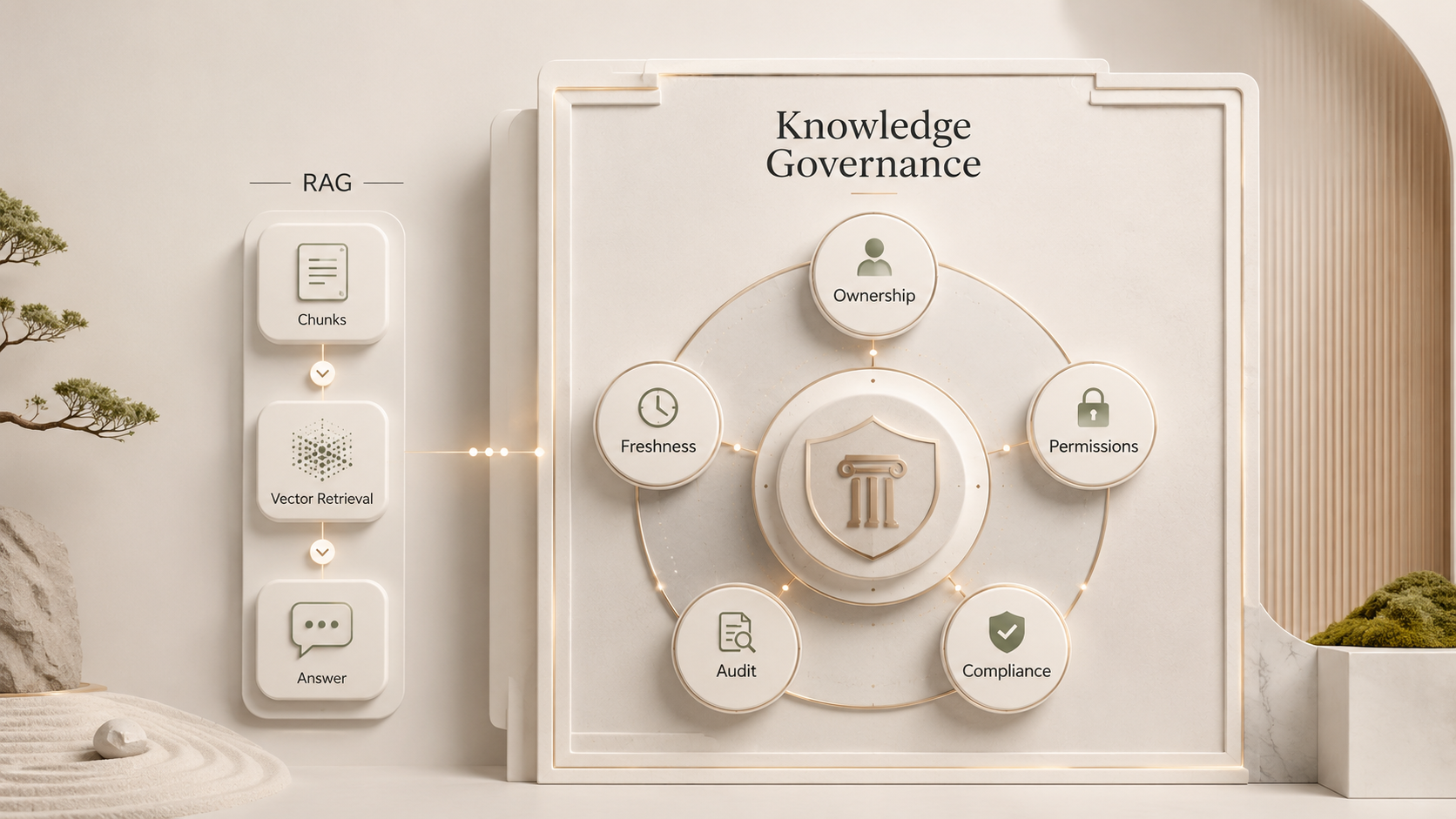
Here's a deliberately controversial take, and I'll defend it: retrieval-augmented generation is, at this point, essentially a solved engineering problem.
Chunk your documents, embed them, store the vectors, retrieve the relevant ones at query time, feed them to the model as context. The patterns are mature, the tooling is abundant and increasingly commoditized, and a competent team can stand up a working RAG pipeline in about a week. Are there optimizations left? Sure — better chunking strategies, smarter re-ranking, hybrid search. But these are refinements on a fundamentally solved problem. Embeddings are not where your enterprise AI project dies.
"Knowledge governance is where it dies. And almost nobody is talking about it, because it's far less fun than tuning a retriever.
The Five Governance Gaps
Here's the uncomfortable reality sitting underneath every production RAG system. Each of these is a governance question — not a retrieval question.
Document Ownership
Who actually owns the source documents your AI retrieves from? When the system confidently produces a wrong answer drawn from an outdated internal wiki page that no one has maintained in two years, who is accountable? In most organizations, the honest answer is genuinely unclear — and 'the AI said it' is not a defense anyone wants to offer in a legal or regulatory setting.
Data Freshness
Your vector store is a snapshot frozen at the moment of ingestion. The instant a policy changes, a price updates, or a contract is superseded, your retrieval can begin confidently serving stale information dressed up as current truth. Embeddings don't expire on their own. Someone has to own the freshness lifecycle, and in most deployments, no one does.
Access Permissions
Your retriever's job is to find the most relevant chunk for the query. But relevance and authorization are completely different questions. If the most relevant document is one an employee has no clearance to see, a naive RAG system will cheerfully retrieve it and summarize confidential content straight into their chat window. Retrieval that ignores permissions isn't a clever feature — it's a data breach with a friendly conversational interface.
Retrieval Auditing
When the AI produces an answer, can you reconstruct exactly which documents informed it? For regulated industries, 'the model just knew' is not an acceptable answer to an auditor, ever. You need a defensible chain that runs from the output the user saw, back through the specific chunks retrieved, back to the source documents and their versions.
Regulatory Requirements
Data residency rules, retention limits, the right to be forgotten, sector-specific handling requirements — all of these apply to the content sitting in your vector store, fully and without exception. Embedding a document does not magically exempt it from the law that governed it before. If a customer exercises their right to deletion, that deletion has to propagate into your embeddings too.
Retrieval vs. Governance
Chunking and embedding strategies
Vector store selection and tuning
Hybrid dense + sparse retrieval
Re-ranking and relevance scoring
Query rewriting and expansion
Knowledge Governance (Wide Open) Ownership and accountability for source docs
Freshness lifecycle and staleness detection
Permission-aware retrieval in the retrieval path
Full audit trail from output to source version
Compliance with data residency and deletion rights
The Real Risk
The pattern across all five is impossible to miss: organizations pour their engineering effort into improving retrieval quality, when their real, unaddressed exposure is governance they simply haven't built. A system that retrieves with 95% relevance but leaks confidential documents to unauthorized users isn't a high-performing RAG system — it's a liability.
The most dangerous version of this failure is the one that sounds most confident. The model presents stale, unauthorized, or unauditable content with exactly the same fluent authority it uses for correct, current, properly-permissioned information. There is no retrieval-layer signal telling you something has gone wrong. The governance layer is the signal — and if you haven't built it, the signal doesn't exist.
The Maturity Move
RAG asks one question, and asks it well: can the model find the right information? That problem is largely solved. Knowledge governance asks a much harder set: should this specific person be allowed to see this? Is it still true? Can we prove how it was used, and can we comply with the law that governs it? That problem is wide open — and it's the one that will actually land you in front of a regulator.