
Why Every Enterprise Will Need a Model Router | Saad Ullah Bilal
Back to Blog
Engineering7 min read

Why Every Enterprise Will Need a Model Router

Routing every AI request to the same frontier model is like having your most senior executive answer every phone call. The model router is about to become standard infrastructure.

Saad Ullah Bilal
Saad Ullah Bilal
AI Strategist & Builder
Why Every Enterprise Will Need a Model Router

Imagine an office where every single task — answering the phone, filing routine paperwork, and setting five-year corporate strategy — was handed to the most senior, most expensive executive in the entire building. You'd go bankrupt paying that salary against trivial work, and simultaneously the work would crawl, because one overqualified person can't be the bottleneck for everything.

And yet that is exactly what happens when every AI request in your organization gets routed to the same frontier model by default. It's why the model router is about to become standard, non-negotiable infrastructure — the same way load balancers became standard once we stopped pointing all traffic at a single server.

"

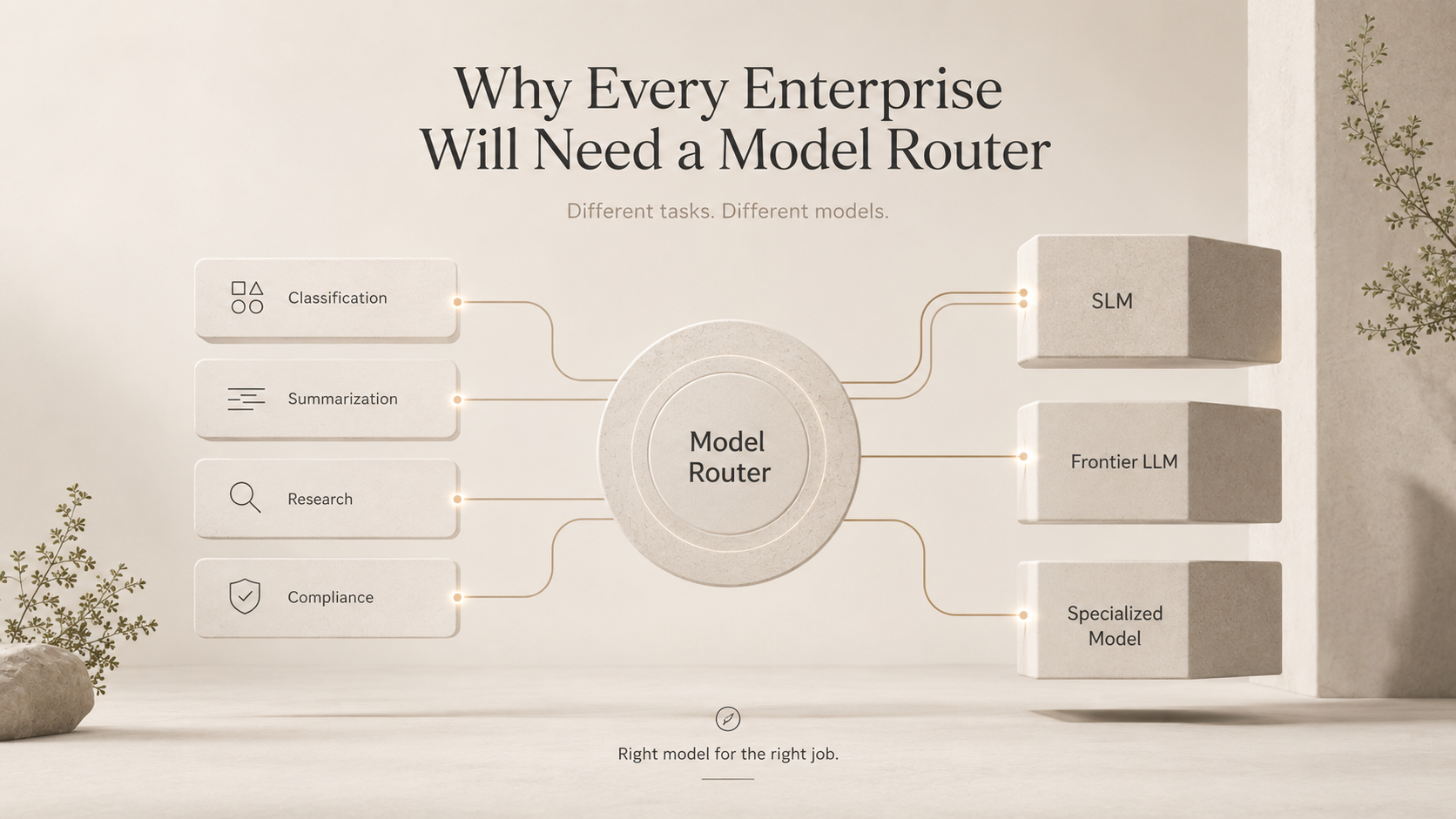
The core idea is almost embarrassingly simple: different tasks should go to different models, matched to the difficulty of the work. Classification → SLM. Summarization → SLM. Research → Frontier LLM. Compliance → Specialized Model.

How a Model Router Works

A model router sits between your application and your fleet of models. It inspects each incoming request — what kind of task is this, how complex, how sensitive, how latency-critical — and dispatches it to the right model for that specific job, rather than reflexively sending everything to the biggest and most expensive option.

Without a Model Router
Every task hits the frontier model
Routine work priced at premium rates
Latency tax on simple requests
Single model = single point of failure
Locked into one vendor's pricing and roadmap
With a Model Router
Each task routed to the right model
Cheap SLMs absorb high-volume work
Simple tasks respond in milliseconds
Fail-over across models and vendors
Swap models by updating a routing rule

The Benefits Compound

Lower Costs
When routine, high-volume tasks flow to cheap small models and only the genuinely hard tasks reach expensive frontier models, your aggregate AI spend can fall by an order of magnitude. Most of your spend is hiding in tasks a small model would handle for pennies. The router finds that waste and eliminates it automatically.
Better Latency
Small models respond faster, full stop. The user waiting on a classification result no longer pays the latency tax of a model built for deep reasoning they didn't need. You reserve the slow, heavyweight thinking for the cases that genuinely require it, and everything else feels instant.
Higher Reliability
A specialized model running a well-defined task is more predictable than a generalist stretched thin across everything. And there's a resilience dividend single-model architectures can never offer: if one model degrades, gets rate-limited, or goes down entirely, the router fails over to an alternative. Your whole AI capability doesn't share a single point of failure.
Vendor Independence
A router decouples your application from any single model or vendor. When a better, cheaper, or faster model appears — and in this market, one always does — you update a routing rule instead of rewriting your application. The router is your insurance policy against lock-in in a market that reprices itself every few months.

The Maturity Move

The single-model era was a phase — the natural simplicity of getting started, not a destination anyone should want to stay at. The mature, durable pattern is a portfolio of models with intelligent routing in front of them.

Before long, 'which model are you using?' will sound exactly as quaint as 'which physical server is your app running on?' The answer will be: it depends on the request, and the router decides.