
If you only read the popular AI discourse, you'd come away convinced that the only architectural decisions that matter are about three things: which model, which agent framework, and how to wire up RAG. Pick the right model, plug in the right orchestration library, get retrieval working — and you're done.
That's an accurate description of how to build a prototype. It's a wildly incomplete description of how to run AI at enterprise scale.
The Five Layers That Actually Matter
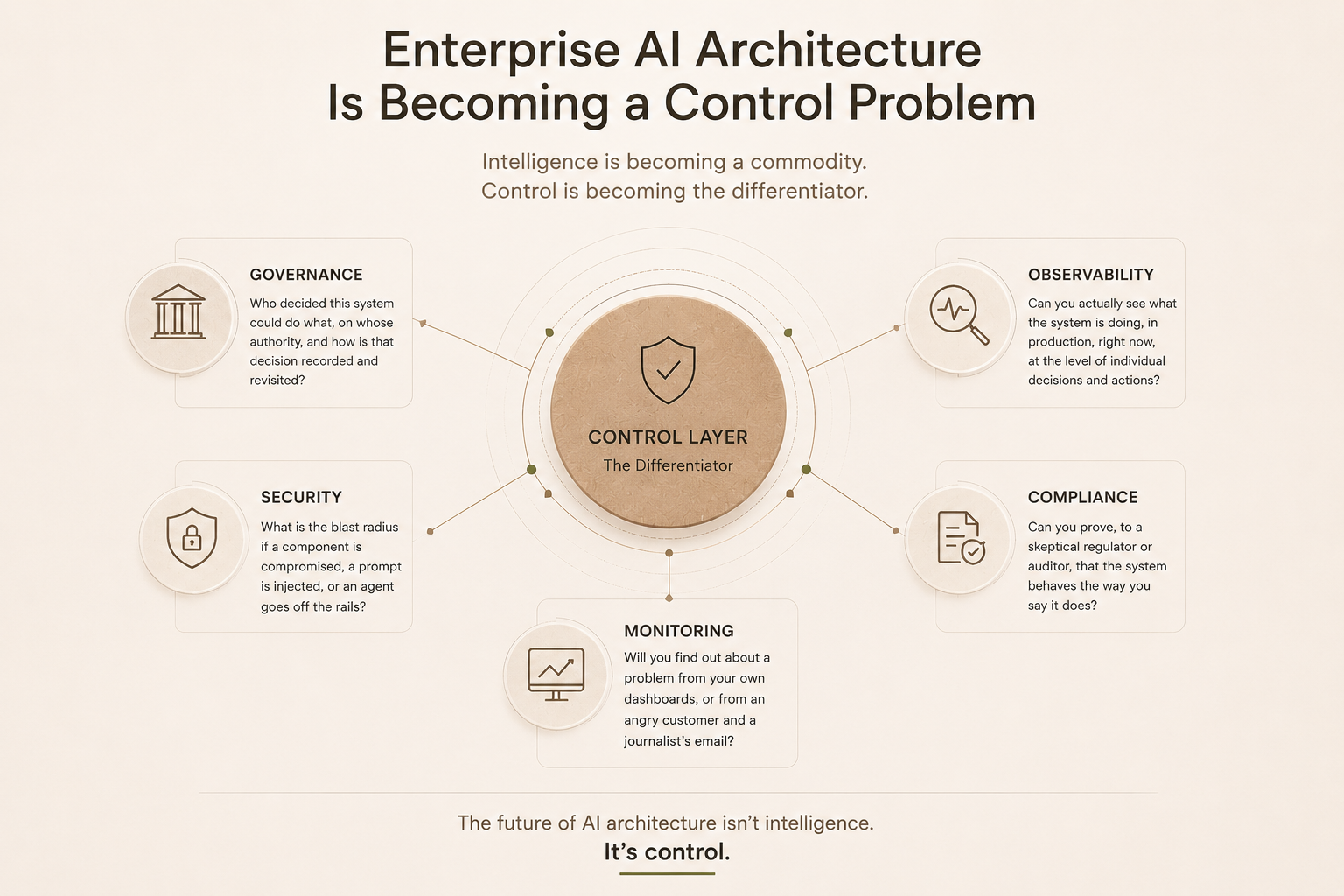
The conversation that actually determines whether enterprise AI succeeds is almost entirely different. It's about five things — and notice that not one of them is about making the model smarter.
Intelligence Is Becoming a Commodity
The intelligence itself is, increasingly, becoming a commodity. Capable models are getting cheaper, more available, and more interchangeable by the month. When the smartest component in your stack is something anyone can rent by the token, intelligence stops being your differentiator. What becomes scarce is the control layer wrapped around that intelligence.
What genuinely separates serious AI organizations from the ones still stuck in pilot purgatory is the governance, the security, the observability, and the proof. The hard part of enterprise AI was never coaxing good output out of a model in a controlled demo. The hard part is operating a probabilistic system, at scale, in an environment where mistakes carry real consequences and accountability is non-negotiable.
We've Been Here Before
We have, importantly, been through this exact transition before. The internet didn't become enterprise-ready the moment browsers got good and pages loaded fast. It became enterprise-ready when we built the surrounding layers: identity, access control, audit logging, encryption, network segmentation, monitoring, and incident response.
The Maturity Move
AI is hitting precisely the same inflection point the internet hit two decades ago. The raw capability of 'computers can talk to each other' was necessary, but it was never sufficient. The enterprise value was in the control fabric woven around it. The next decade of enterprise AI architecture won't be primarily a story about smarter models.
The future of AI architecture isn't intelligence. It's control — governance, security, observability, compliance, and monitoring, built to a standard that lets a regulated business stake its reputation and its license on the outcome.