
Almost every impressive agent demo you've seen was optimized for exactly one thing: showing what the agent can do. The flashier the autonomy, the better the demo. Watch it book the trip, refactor the codebase, file the report, all on its own.
Enterprise deployment cares about something close to the opposite: defining, with precision, what the agent is allowed to do. And that single difference in framing is the entire gap between a demo that goes viral on social media and a system you'd actually let near a production database holding real customer money.
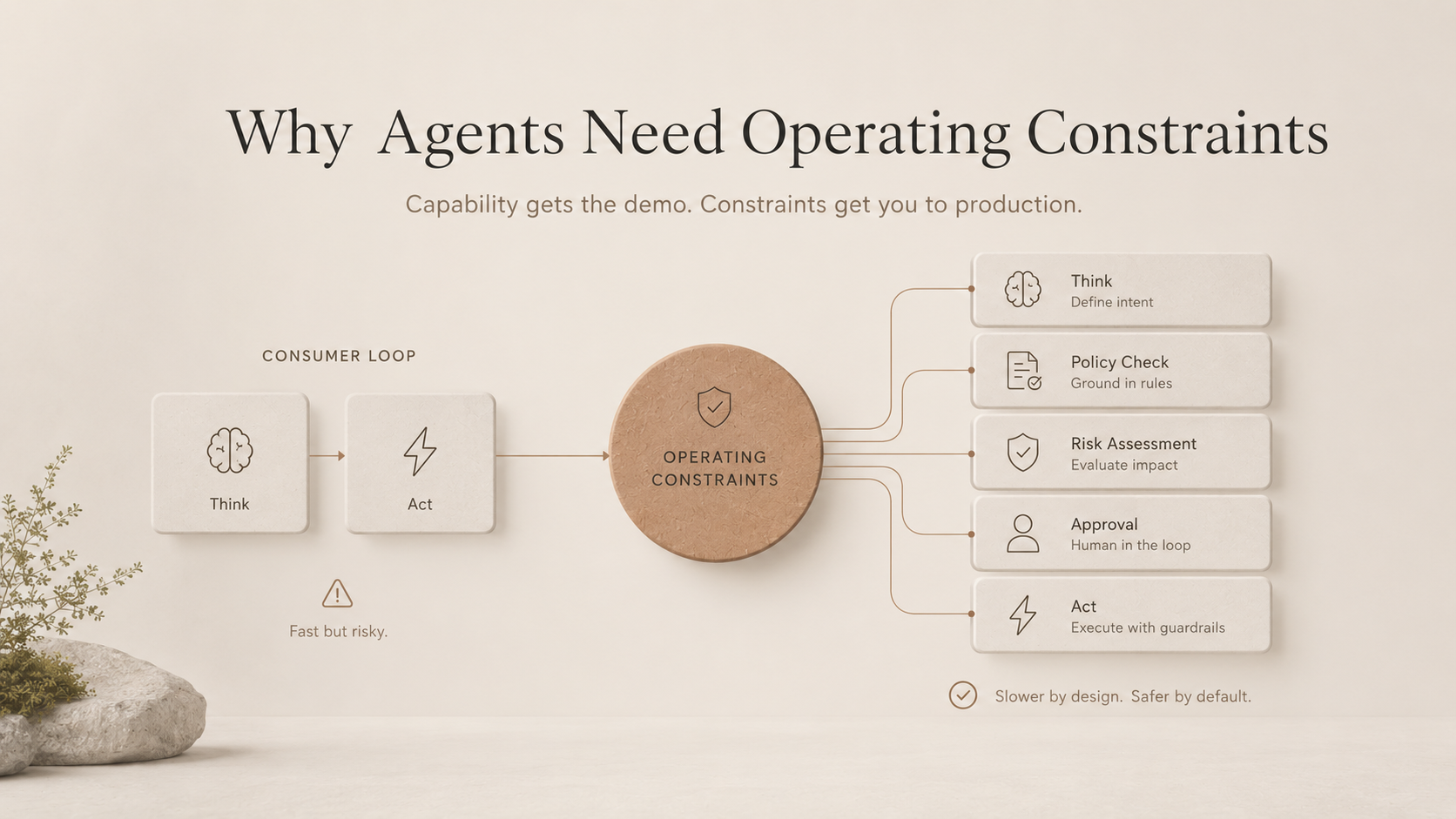
The consumer-grade loop is Think → Act. Clean. Fast. Genuinely impressive. And in an enterprise context, quietly terrifying — because there is nothing standing between a plausible-sounding plan the model invented and a real-world action with real-world, possibly irreversible, consequences.
The Real Decision Framework
The consumer-grade agent loop powers the demos. The enterprise loop looks fundamentally different — look at how much deliberately sits between the thought and the action:
When Small Models Win
The Maturity Move
The mistake people make is treating these constraints as a tax on the agent's intelligence — friction that makes it dumber or slower. It's the reverse. The constraints are what make the intelligence deployable.
A brilliant new employee with no manager, no policy to follow, and no approval process for big decisions isn't an asset to the organization — they're an incident waiting for a calendar date. We don't onboard talented humans without structure; we shouldn't deploy capable agents without it either.
Capability gets you the demo and the applause. Constraints get you to production and keep you there.