
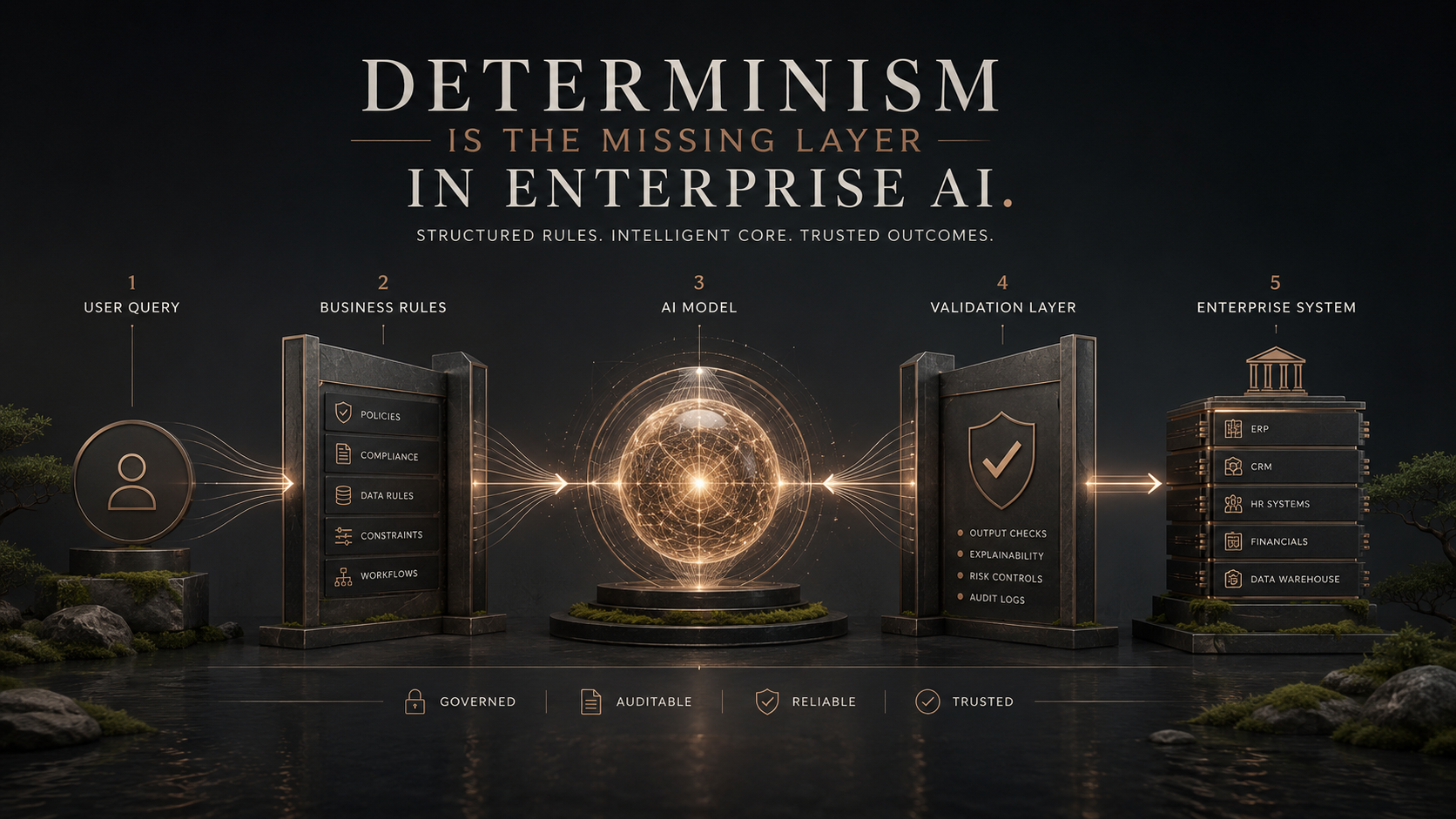
Consumers forgive AI. Enterprises can't. That single asymmetry explains most of why so many impressive AI demos never survive contact with a regulated business.
If a consumer chatbot recommends a slightly wrong restaurant, you shrug and move on. If an AI system inside a bank misclassifies a transaction, miscalculates a refund, or approves something it shouldn't have, the consequences arrive with auditors, regulators, and occasionally lawyers attached. The error budget that consumer products run on simply doesn't exist in the enterprise.
We've spent the last couple of years optimizing relentlessly for capability — smarter, broader, more fluent — and almost no time engineering for predictability. Yet predictability is exactly what high-stakes, regulated workflows are built on.
A compliance officer doesn't want a creative answer. They want the same correct answer every single time, and they want to know why it was correct.
The Fix Is Architectural
Here's the part people get wrong when they try to solve this: the fix is not to make the model itself deterministic. Large language models are probabilistic by their very nature. Asking them to behave like a deterministic function is fighting the physics of the thing. Pretending you can prompt your way to guaranteed behavior is wishful thinking that fails at the worst possible moment.
The actual fix is architectural: wrap the probabilistic core inside deterministic structure. You don't make the model perfect; you make the system trustworthy.
The Four-Layer Stack
Read this top to bottom and notice the AI model is only one stage — deliberately sandwiched between guarantees on either side:
When Small Models Win
The Maturity Move
Too many teams treat human review as something to be embarrassed about — a sign the automation isn't 'done.' That's backwards. You get speed and accountability instead of trading one for the other. The AI does the heavy lifting of preparing the work; the human owns the judgment call.
Stop trying to make the model trustworthy enough to act alone. Instead, build a system in which it doesn't have to be. Determinism isn't the enemy of AI in the enterprise — it's the layer that makes AI usable there at all.