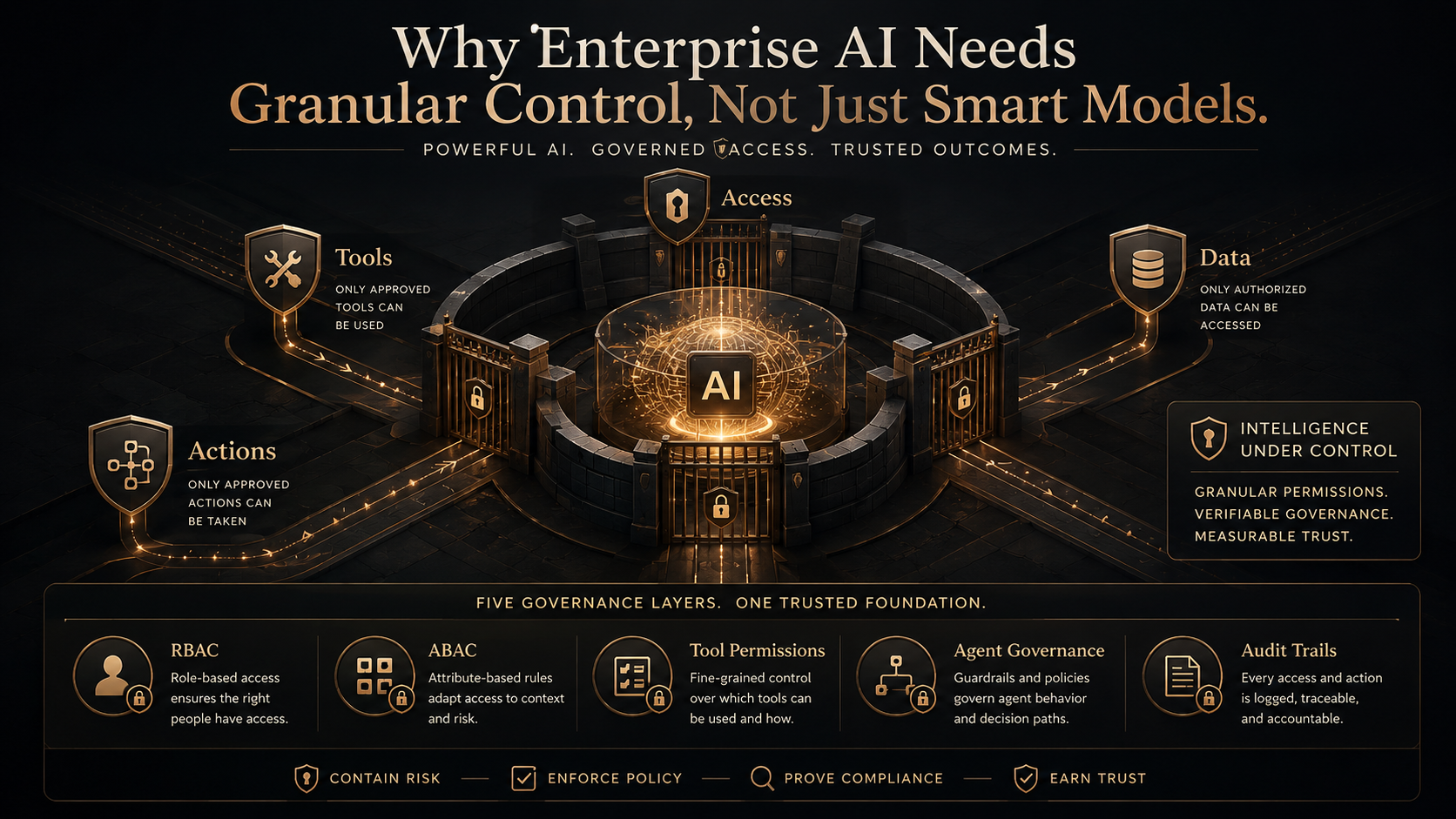
Why Enterprise AI Needs Granular Control, Not Just Smart Models
The models are already smart enough to do real damage. The constraint on enterprise AI was never intelligence — it's control.
Saad Ullah Bilal
AI Strategist & Builder
April 14, 2026
We keep asking whether the models are smart enough. It's the wrong question, and it's quietly steering enterprise AI strategy in the wrong direction.
The models are already smart enough to do real damage. They can already read sensitive data, call powerful tools, and take consequential actions. The constraint on enterprise AI was never intelligence — it's control. Specifically, control over four things:
Who can access what
Which tools can be called
Which data can be retrieved
Which actions can be executed
"
Get those wrong, and your 'AI assistant' quietly becomes the most over-permissioned entity in your entire organization. It never sleeps, it acts in milliseconds, it can chain a hundred operations before a human blinks — and unlike a human employee, you can't pull it into a room for a quiet conversation about judgment.
The Control Stack That Actually Matters
An over-permissioned human is a risk. An over-permissioned AI is a risk operating at machine speed and machine scale. Here's the control stack, layer by layer.
RBAC — The Floor
Role-Based Access Control is necessary but only the beginning. The AI inherits the permissions of the role it's acting on behalf of. A support agent's assistant sees support data; it does not see the finance ledger. Simple, essential, and on its own, not nearly enough — because roles are coarse, and the real world is full of nuance a role label can't capture.
ABAC — Where Serious Enterprises Operate
Attribute-Based Access Control adds context: department, data sensitivity classification, time of day, geography, channel, request context. 'A manager can approve expenses under ten thousand dollars, within their own region, during business hours, from a managed device' — a sentence ABAC can express and RBAC simply cannot.
Tool Permissions — What the AI Can Do
Separate from what it's allowed to see. Reading a record and deleting one are radically different risk profiles, even though both touch the same data. Every tool an agent can call is a door, and every door needs a lock. The default for any new tool should be denied, with access granted deliberately — not the reverse.
Agent Governance — The Sequence Problem
What happens when the agent chains several actions together? This is where individually-safe steps combine into a decidedly unsafe outcome. Governance defines the boundaries the agent operates within across an entire workflow — not just per-action, but cumulatively. It's the difference between approving each step and approving the journey.
Audit Trails — Nobody Appreciates Until They Need It
Every access, every tool call, every action — logged, attributed, timestamped, reviewable. When the regulator asks 'what happened on the fourteenth,' the answer cannot be a shrug and a stack trace. In regulated industries, a system without one isn't deployable, no matter how smart it is.
The Real Decision Framework
Over-Permissioned AI
Accesses everything by default
Tools granted, never reviewed
Actions chain without boundaries
No log of what happened or why
Risk at machine speed and scale
Controlled AI System
Least-privilege access by design
Every tool explicitly approved
Governance spans full workflows
Complete, reviewable audit trail
Safe to deploy in regulated environments
The Maturity Move
The throughline across all five layers: a genius with no boundaries is a liability, not an asset. We've always known this about people — it's why we have org charts, approval limits, and access reviews. We're now relearning it about AI.
The next wave of enterprise AI won't be won by whoever has the smartest model. Smart models are becoming abundant and increasingly interchangeable. It'll be won by whoever controls theirs most precisely — who can say, with confidence and proof, exactly what their AI can see, touch, and do, for whom, and under what conditions.